Sidedressing nitrogen: The rationale, past research & potential risks in split-applying
Hello and welcome back to Advancing Nitrogen Smart, the special podcast series from University of Minnesota Extension. I am Jack Wilcox as always in Extension Communications.
Jack Wilcox:Today I'm here with Brad Carlson, Extension Educator from the Mankato office, and Daniel Kaiser, Extension Nutrient Management Specialist in Saint Paul.
Jack Wilcox:Today we're going to discuss side dressing. Brad, what's the thought process behind side dressing nitrogen?
Brad Carlson:Well, in a in a big picture sense, the the idea of splitting the nitrogen, of course, is that you're being more efficient with nitrogen use and that you're potentially able to lower the amount of nitrogen that the crop needs, and you're gonna lose less nitrogen. So if you really boil it down, though, what you're what you're trying to do is avoid the lost processes of nitrogen. And so we've talked, you know, forever about lost processes being water based. So the idea is that there's a risk of losing the nitrogen between the time you apply it and the time that the crop actually needs the nitrogen. And so you're just simply avoiding loss by it not being out there during those high stress periods, which tends to be spring, really.
Brad Carlson:Historically, we're we're generally dry in the fall. I mean, that's there's been definitely been some exceptions to that. However, we really only recommend applying anhydrous ammonia in the fall, and that's not a big risk to loss when it's really wet. So we're really looking at that spring window. And I guess when you really break it down, though, because that's what you're trying to do is avoid those loss times.
Brad Carlson:If you don't have that stress or potential for loss, it really doesn't matter a whole lot. And so that's kinda what what this kinda comes down to is, you know, the crop, and we've said this a 100 times. There's no such thing as spoon feeding the crop. There's no such thing as fresh nitrogen. It's either there or it's not.
Brad Carlson:And so if you applied it early and you didn't lose it, well, then it's still there for the crop to take up. And and so the idea with sidedress, though, is that, you know, there are situations, some of them out of your well, they're pretty much all out of your control, but some of them are knowable and some of them are not knowable. The knowable ones are poorly drained soils, and so the coarse textured soils. The unknowable is always the weather. We don't really know exactly what the weather is gonna come out with us.
Brad Carlson:And so that's really that that's really the crux of this. And so split application has become more popular, I think, particularly with a lot of farmers who use it as a sort of a confidence builder. I think there's you know, we've talked about that we don't want to be applying insurance nitrogen. It's not good for your pocketbook, and it's not good for the environment. And that's just simply applying more nitrogen than you need because you think you're gonna lose it.
Brad Carlson:You know, if you're if you're inclined to wanna do that, then split applying is one way to avoid that because you're just simply not putting it on, avoiding those loss periods until we get to the point where the crop needs it. And so there was some seminal work that was done out of Illinois looking at when the crop needs nitrogen. And, you know, it really kinda gives us a lot of guidance on when, when split applications, should be happening.
Dan Kaiser:And if you watch your crop, I mean, one of the things that you'll see is the a lot of the uptake follows what you see visually with the growth of the crop itself. The uptake of nitrogen isn't constant over time. It isn't a linear response. It's if you start looking at the demand early in the growing season, up through about, you know, when the crop's about a foot tall, which is, you know, roughly the v four, v five time frame that only about 10% of that whole nitrogen taken up during the year is taken up at that point in time. And, you know, early on in the season too, we know that the seed does contain some nitrogen, so the the the crop itself to get established doesn't really need it.
Dan Kaiser:And in the case of a lot of our soils in Minnesota, if you're have corn following soybeans, some of the residual nitrate that was mineralized at the end of the last growing season that might still be there in the soil typically can tend to supply the crop with enough nitrogen to get us well into v six, you know, v eight, v 10 before we start seeing some issues. And, you know, really key when you start looking at the peak demand for nitrogen that it occurs somewhere between about v six and r one and r two where, you know, roughly 60 to 65% of the nitrogen is taken up by the crop. And I'll hear that every once in a while, growers will talk about you know, you you read in the magazines this extra 25% nitrogen that's taken up post tasseling that a lot of times will start talking about later applications, and it really doesn't make a lot of sense for us here in Minnesota because we tend to get a lot of mineralization at that point in time. And the the curve, you know, you can see a lot of times is the the percent total uptake over time.
Dan Kaiser:Really, what's more important is kinda turning that on its head and looking at the daily demand. And what you see really around, you know, v 10 to v 14 is where you see peak daily demand of nitrogen. So that's when we wanna make sure we have the most availability. So when we start talking about sidedress, a lot of our recommendations are really looking at trying to get the sidedress applications, any planned sidedress out before, I would say, v eight v 10. I mean, really is where you want want it's kind of the key.
Dan Kaiser:And with continuous corn, we recommend having something up front. Anything, certainly, you could side dress the bulk of all of your N in a corn following soybean situation if you put it on early enough. But corn following corn, that's not gonna be the case because, you know, what I talked about before, that residual nitrate, it becomes more of an issue in corn following corn just because of what the we see for residue immobilization. So people start getting real kind of talk about Brad talked about the spoon feeding philosophy and, you know, for something like irrigation where you have made a fertigation, it might make more sense to do more smaller applications over time, because the leachability of the nitrogen is gonna be greater at that point. But from what we've seen, I mean, if you look at a lot of the data in Minnesota that, and I can kinda talk about this here a little bit later, but it really doesn't make more sense if you're gonna go and do just a split application to go in more and just apply more than one time in season, unless you're dealing with, some sort of rainfall event where you're looking at a rescue and treatment, and that's a whole different animal itself.
Dan Kaiser:So, you know, really, that's one of the things that I you know, I'll talk to growers or when I'm talking in front of growers, I'll talk about is you get a lot of information now that's in these farm magazines that's more national. And there might be a reason why in some areas of the country that a later application might be beneficial. But for us, really, the best data is local and that our conditions aren't necessarily the same. So really, really, I think it's really important to have nitrogen applied during that peak uptake period, which, you know, v eight really is kind of the, I think, the the latest starting point I would look at going for sidedress application. You wanna have maximum availability at that point in time to make sure you meet meeting peak demand.
Brad Carlson:And I think it's also important to realize that on the front side, there's not a lot of sensitivity to that timing. So we have years when, we have great weather conditions, the crop gets planted early, you know, farmers have split their nitrogen, so they've only got half of it on. And so now you're sitting around waiting, to do that split application until you know, on on a typical year that happens about the first week of June, when we hit that v four or six stage. But there's really no great reason to wait, for instance, if it's the third week of May, because the risk of losing that nitrogen over that extra two weeks really isn't that great. And so, you know, we always say that that that, you might as well just put it on if the conditions are good to put it on because we have had years when it started raining, and then it became difficult to get in the field without getting into the mud.
Brad Carlson:And and so that that's an important point, I guess, philosophically for guys to be thinking about. So you've you've planted it, and the seed is not even emerged. The plant's not even emerged. Can you start side dressing nitrogen already?
Brad Carlson:Yeah. You can. And, most years, it's not going to show a great, a great risk to loss.
Dan Kaiser:No. And that's really key. I mean, really looking at application. I mean, our recommendation really, as soon as you can roll the crop is a good time to start side dressing. And, you know, looking at risk, before I started here in Minnesota, I think just right before, Jeff Vetsch and Giles Randall finished up a study where they had, oh, how many sites were, 25 sites?
Brad Carlson:Lots.
Dan Kaiser:Yeah. Where they were looking at pre plant versus, I think, just small amount of an applied as a starter than the rest put on as a sidedress application in different rotations, different times as they're working with different farmers in terms of when the N was applied. I think the latest applications they had were around v 12, so kind of right in the heat of that that really rapid uptake period and as early as v six. So it was kinda somewhere within that range.
Dan Kaiser:And if you looked at the data, it was interesting, because really only one out of 25 sites had a positive yield response to sidedressing. 16 of the 25, it was the same. So, essentially, in those cases, didn't really matter pre plant versus sidedress, that the similar response. Eight out of the 25, though, they had negative responses.
Brad Carlson:And I think it's worth mentioning, Dan, that one out of 25, I mean, when you look at just standard experimental analysis, that could just be random error. That could have that it's not necessarily even the sidedress that caused that. There could have been some other factor that led to that, and that really does lend credence to the whole idea that there's no such thing as spoon feeding the nitrogen, that the the crop really didn't care that the nitrogen got on recently because it didn't you know, if it did, it would make a positive yield impact.
Dan Kaiser:No. And a lot of the issue too were from what they were seeing. If you look at a lot of those eight out of 25 sites or the they actually got a negative response to the sidedress. Kinda a couple things came into play. One, it was some of the late applications, so v v 10, v 12 or later.
Dan Kaiser:And then there's situations too where they didn't get a lot of rainfall. What I think, it was Iowa State John Sawyer. They looked at some of this in kinda, what was the key period for sidedressing? What they found is, really what's key for success is, the amount of rainfall within a three week period post application, because rainfall is important.
Dan Kaiser:I mean, certainly even with coulter injection to get the nitrate to the roots because most of the N taken up in the corn crop here in Minnesota is gonna go through as nitrate. So nitrate is water soluble. It moves with the water. So when it comes to uptake, most of the uptake is gonna be incurring at points in time where the crop is accessing water from the soil. So if you've got dry periods or, you know, situations where that nitrogen is just letting near the surface, you're likely gonna see positional what we call positional unavailability or where the roots essentially are taking up water at a point where the nitrate isn't, and it isn't getting into the plant.
Dan Kaiser:So that's kinda what they found with a lot of the study. What other people have seen is one of the issues with those those later applications is you have to have time for it to get to the root. So that's why earlier generally is better, at that point in time and why I really wouldn't recommend going much beyond about v six for a planned sidedress application because you start risking issues if you do get into a dry year that it's not gonna get into the plants. So, you know, waiting too long, I don't think there's really a benefit to waiting. I mean, the only thing that we've been doing now for research for the later applications is with some of the remote sensing work that's being done.
Dan Kaiser:You almost have to wait to that v 10 range, and then you start getting into some issues where you're risking, yield loss, with those late applications just because we if we don't get rainfall, you might not get the nitrogen into the plant.
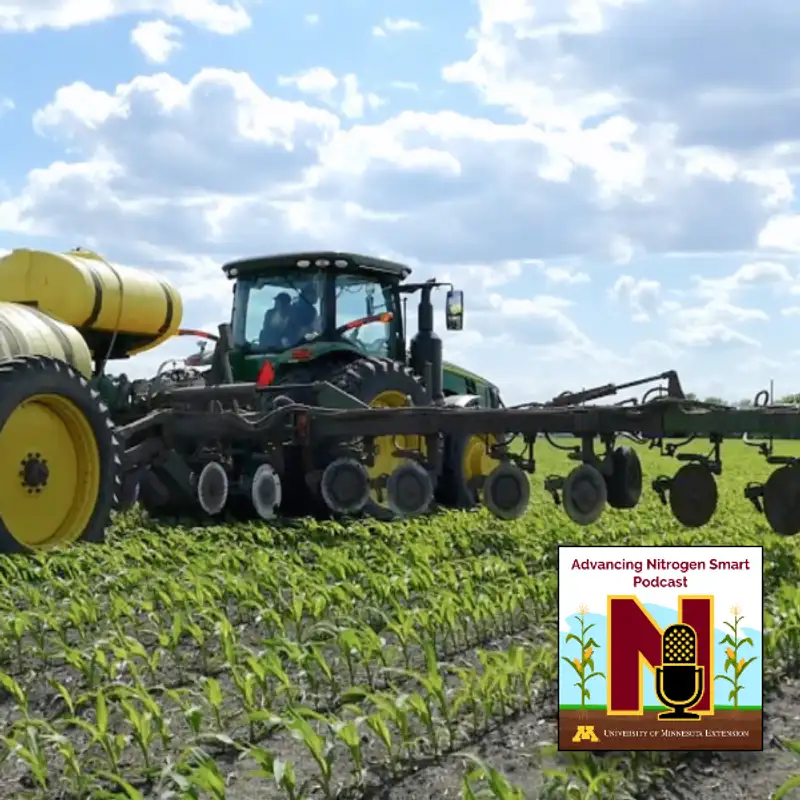
Brad Carlson:And I think it's also worth mentioning that a lot of, what we call sidedress, is actually that that what we also would call top dress. That's become very popular over the last ten, fifteen years because of the availability of equipment. You know, it's we we're used to our row straddling equipment that does herbicide applications, you know, over the last decade plus. Most of the fertilizer dealers now have boxes on that equipment where they'll they'll come in and straddle the rows and just blow urea on with a a spin spreader or they'll use some airdrop nozzles or some airdrop tubes or something either or, and then just lay urea right on the surface. And so that's also important to remember that, you know, there is a risk of losing that urea because it's not being incorporated.
Brad Carlson:So, you know, the later that gets you you're getting into warmer temperatures that are gonna run a higher risk for that also. Also important to kinda keep an eye if that's your, your application method. One, we typically recommend a urease inhibitor. You know, there's general rules of thumb. We like to see a quarter of an inch of rain.
Brad Carlson:We don't want it to you know, there to be anything that happens in the first four days ish or so. But if it gets hot, that whole whole thing can get sped up, and we've seen that in some of our research projects at the research stations. You know, we had some applications, a few years ago that had, urease inhibitor on them, but it was, like, a 100 degrees, and we were seeing burning on all the plants. And so, you do also need to kinda keep track of that, not so risky earlier. By the time we get to mid June, though, we're getting into a lot of risk period for that.
Dan Kaiser:Yeah. And it just makes sure if you're using any of these inhibitors that they are actually inhibitors because there's a lot of quote, unquote nitrogen products out there that claim to have some of the same inhibition effects as something like NBPT, which is the active ingredient in Agrotain, Limus, Agrotain, the NBPT generics. What's the other one? I can't remember if there's another one that Koch has out there. I mean, they all have shown efficacy, so you just wanna kinda make sure that the product that you're applying is applied at a rate that, one, the product's effective, but, two, the rate that it's applying is effective.
Dan Kaiser:But there are several really good products out there. And I think one of the advantages, you know, switching to more of a urea based system in some of the areas of the state that sidedress has the fact that it lengthens the time for application because in one of the worst times for application, particularly for South Central, what is the worst time for South Central Minnesota is in the fall, and we don't wanna see that. So, you know, the having the option for lengthening out that window so fields can get planted, there are several things we can do, and sidedress, I think, is one of those options. So even if we don't have a definite yield advantage or an advantage in reducing the amount of N, sidedress does give the option for more time to get the N applied. It's just I wouldn't wait as long.
Dan Kaiser:I think the limiting factor, Brad, we've run into essentially is a lot of the equipment that the the dealers, the high clearance equipment they use, they switch back and forth from spraying. And a lot of times, they have to wait to get the spraying done before the boxes go on. So sometimes there can be a little bit of a delay in when the N is supplied, just because of equipment availability. But, you know, with the fertilizers we have out there and the sources and some of the inhibitors, there's there's a lot more flexibility we have now than than we did in the past.
Brad Carlson:So let's talk just a little bit about kind of targeting or or making kind of advanced plans for sidedress. Dan, you already alluded to the whole irrigation situation, and we're not gonna spend a lot of time talking about irrigation here on this particular podcast. But the research definitely has shown that there's advantages to multiple splits on irrigation, and that, of course, is because of the soil texture and the high potential for loss. You're better off just avoiding having that nitrogen out there at times when you we do get, you know, good rainfall, you know, in those sandier soils, it can still be lost. The other part of that, though, the the exact opposite of that, the the one eighty is our real heavy soils in South Central Minnesota.
Brad Carlson:Now I realize that, you know, we're we've got pattern tile drainage across large portions of the state at this point. And and in a lot of cases, it's adequate drainage, you know, to maximize the yield potential, but that still doesn't take away the fact that we've got clay loam textured soils. And so if we're getting periods when it's really wet, those soils will stay saturated for a long period of time. And and, the the data shown at Waseca, you know, it's not consistent year after year. But in in a wet year, we will get nitrogen loss, you know, in that early June time frame after the soil start getting warmer, and there can be an advantage to side dress in some of those.
Brad Carlson:Similarly, Jeff has done, some more recent research in the Southeast Minnesota, not on those heavy textured soils, but the places where they're finding the advantage for a side dress as opposed to just simply applying it all preplanned is kind of that transition zone running from, Rice County down through Dodge and Mower County, where we've got old till underneath and that kinda loess cap, on the top. We don't see a lot of wetlands in that area. It doesn't look like a wet landscape, but the farmers who farm there know that most of it does have tile drainage because that old till underneath is poorly drained, and they have seen a a fair amount of nitrogen loss. And I guess, you know, they're not necessarily measuring nitrogen loss, but they're looking at the results of the study and saying it has been lost because they're getting a big advantage to sidedress in a lot of those landscapes.
Dan Kaiser:Yeah. And, I mean, really looking at it too. I alluded this before. There's been some work also looking at late applications, and there just is no advantage in a lot of these soils. Some of the stuff that Brad was talking about, I mean, really, the post tasseling, it was really big, around, you know, 2015 or so.
Dan Kaiser:There was a lot of talk about coming in with high clearance equipment post tasseling and putting on additional twenty, thirty pounds a n. And really, the data we've seen when we have had a benefit, really, it's been to the split with the pre plant and the v six application. If you look at, a three way split, you know, outside of irrigation, and as Brad said, we're not talking about irrigation. There are some definite advantages to three, four, you know, maybe five applications in nitrogen on some of our very sandy soils, which is easy to do if you have a fertigation system where you can, you know, continually put on a little bit of an over time. With most of our our non irrigated soils, I mean, if you look at, you know, two applications versus three applications, you see similar results.
Dan Kaiser:So, you know, in effect, we don't really recommend any more than that single split on some of the soils that Brad was talking about. You know, Fabian Fernandez, when he started around 2015, actually took over a study that John Lamb had started where we're looking at timing of applications. And what Fabian did actually is when he came in is he expanded the sites into some different soil types, looking at situations with different spring N loss potential. And, really, what he found is, you know, when it comes to split applications that the highest yield potential, if you looked at v two versus v eight, there wasn't really any difference in terms of yield potential with split applying at those different times. It's when he got in situations with low spring and loss potential situations like Brad was talking about, like going to v 12, there was some potential reduction just because of waiting too long and dry summers too.
Dan Kaiser:I mean, looking at that, if you don't have N loss occurring, that's, really then pre plant versus split, there's no advantage. But waiting too long against is a problem. And it's really in our irrigated situations where timing is more critical and waiting a little bit longer becomes more important, just because we know I think what is it, Brad, that in sandy soils that with an inch of drainage, we can move nitrate at 12 inches?
Brad Carlson:Yeah.
Dan Kaiser:So, I mean, you have to think about that where it takes it's like six inches in some of these these these heavier sites. Correct?
Brad Carlson:Yeah. And and so, I mean, realistically, if you think of you figure the corn's rooting three feet deep, you know, if you've got an extra three inches of of water percolating through the soil in a sandy soil, you're gonna move it below the root zone. Typical the the typical amount of water we would see coming out of a drainage system in Southern Minnesota is gonna be in the order of about eight acre inches a year. When you measure it, if you're kinda calculating that out, obviously, that's gonna vary a lot depending on the drainage system and the, you know, the soil types and all kinds of things. But it's at least a kind of a reference point.
Brad Carlson:And so if you think about eight inches coming out, you know, draining out of a site, you know, it's easy to see. And then why in irrigated sandy situations, you can get in trouble in a hurry because, you know, basically, you know, not even a half, you know, almost like a third of what your total loss is, you're able to actually and I'm gonna say loss of water is, you're able to actually lose a lot of your nitrogen too in that amount of time. So that's that's really why we see the great advantage in those sandy soils. You know, as you said, Dan, fertigation is a great opportunity to mitigate that and get around that. Of course, if you're not fertigating, you know, then you gotta start thinking about the application cost.
Brad Carlson:But it is one reason why, for instance, you know, the part of the state where we still see a lot of sidedress anhydrous ammonia is in those sandy soils. Like in Dakota County, they still do a lot of side dressing with anhydrous. That is, again, is just a a factor to try and mitigate or prevent that loss because that anhydrous is gonna stick around just that little extra longer than the other fertilizer types.
Dan Kaiser:Our typical BMPs for sandy soils have been just two applications of n. I think with more urea based systems and UAN, I mean, we need to up that. What I've been finding with a lot of my studies, you know, at least four or, well, three to four splits where you spread a little bit of preplant and then kinda stretch things out seems to be more important. And that's a lot of it because of the precipitation we're getting. If we're getting wetter, that becomes more of a situation where we have to consider, you know, changing things.
Dan Kaiser:I mean, the other thing too is, if we're getting into warmer climate or if we're getting wetter, I mean, do we need to delay to those later applications? And I don't think so right now. You know, even if you look at those those post tasseling, we just have not seen the advantage to it. And I think the reason for that, and I mentioned this before, is we've got a lot of organic matter in our soils, and we get a lot of mineralization late in the growing season. That mineralization can meet the demand of the crop towards the end of the growing season, where if you the farther south you go, you get soils that are more weather, lower organic matter.
Dan Kaiser:That might not be the case. That additional twenty, thirty pounds, that might be short. I mean, you get into some place like Missouri or farther south versus here in Minnesota. So that's where if you look at late applications, we've just struggled to get those to work. So if you're splitting, I mean, really, that's I won't be changing.
Dan Kaiser:You're looking at we're looking at some of our best management practices now. I mean, a lot of the wording in it says, you know, try to get stuff on by about v six. I think v six to eight v eight is probably that late window that you wanna try to get your plan splits on if you're gonna do it and not really worry about it any later than that because a lot of times, if you look at those late applications, you can see a lot of the nitrogen laying there in the the soil at the end of the growing season. The plant just never really needed to take it up.
Brad Carlson:Yeah. And I wanna stress, Dan, what you just said about the the late season and the the organic matter part because a lot of that research that really was popular in the farm press 15 ago did come out of Missouri. There was some out of Kentucky. There was some out of Kansas. Those are places where we only see one, one and a half percent soil organic matter.
Brad Carlson:They don't have the ability to supply the late season nitrogen we have in Minnesota. And so the the there's a reason why they were responding, and we don't see the advantage of that in Minnesota. You know, the other side of that is is if it's so dry that we don't get mineralization, it's also too dry. You're probably not gonna get nitrogen uptake from that late season N either. So it's just again, we just unless it's and, yeah, even a rescue treatment, it's just getting so late in the year.
Brad Carlson:It's kinda questionable. We just don't like to see that going on, you know, at tasseling time and later.
Dan Kaiser:Well, I think a lot of times growers get buy a piece of equipment. They wanna try to get extra use out of it. So that's where we start getting into that. So they start looking at investigating some other things, and really doesn't make any sense. I mean, we're seeing it now with sugar beets where some growers are talking about in season application when all of our data really has shown that split application doesn't take advantage.
Dan Kaiser:I think a lot of those growers have invested in Y drops, and they just wanna use it on more acres to get more value out of it. And, I mean, the issue with it is is it just the the science isn't necessarily there. And the thing is, you know, I'll go back to a comment, you know, kinda to wrap up here than made before is with any of this information you're getting, just look at where it's coming from. In local data, generally, is better because you have to kinda know what the soil types are in the areas that some of these, some of this data is being generated because it may not be very applicable to what you're dealing with and the condition's different where what they're doing may not necessarily be the best for what you wanna do in your field.
Brad Carlson:Yeah. And I wanna close with just with one more point that we've kinda talked a little bit about, just to kinda hit it a little more head on, and that is the idea that you can lower your nitrogen rate by split applying nitrogen. And I guess it really depends on how you wanna define that. When you look at the data from our nitrogen rate trials, you'll see that roughly 20% of the sites, do require a lot more nitrogen than what the recommendations shake out to be. However, when you start investigating where those sites were and what those situations were, frequently, we are dealing with heavier, wetter soils.
Brad Carlson:And so a lot of that work that Jeff has been doing, get kind of on that fringe area of the Southeast. You know, what he's finding is is, well, use less nitrogen if you're doing a split application. I would kinda argue that, really, it probably needs the same amount of nitrogen that when we talk about the four r's, what it's really telling us is that's just a site that needs split application because when you're applying that higher rate earlier, you're just losing some of it, which, of course, just isn't a great practice. And so it does get into a bit of semantics, but I think, you know, overall, some of those sites that are prone to loss, what you'll discover is if you start splitting the the the nitrogen, you'll those rates actually kinda come a lot more close in line with what the nitrogen rate recommendations are. That barring some extreme precipitation events or or other, you know, really wet years and so forth.
Jack Wilcox:Brad Carlson, Extension Educator, and Dan Kaiser, Extension Nutrient Management Specialist. Thanks for the information.
Brad Carlson:Thanks.
Dan Kaiser:Thanks.
Jack Wilcox:Do you have a question about something on your farm? Just send us an email here at nutmgmt@umn.edu. Thanks a lot for listening and we look forward to seeing you next time.
Jack Wilcox:Advancing Nitrogen Smart is proud to be supported by the farm families of Minnesota and their corn checkoff investment through Minnesota Corn.